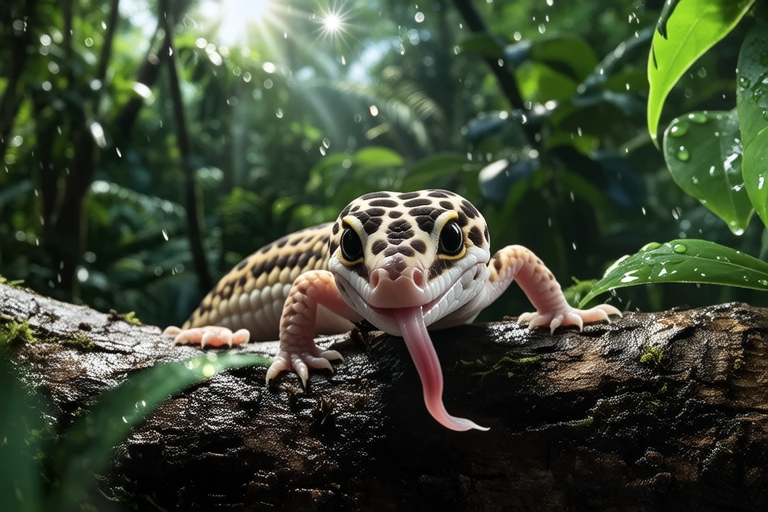
From Desert to Jungle: How Chameleons Rule Every Habitat They Enter
What makes these creatures so uniquely successful? The answer lies not in a single trait, but in a symphony of specialized features that allow them to thrive where few others dare. Their ability to change color isn’t just for show—it’s a survival tool woven into every fiber of their being. Their eyes, independently swiveling like tiny radar dishes, grant them a panoramic view of danger and prey. A tail that acts like a fifth limb, gripping branches with spider-like precision. And a tongue that shoots out faster than a bullet—capable of capturing insects mid-air with surgical accuracy. Together, these traits form a toolkit of survival honed by millions of years of natural selection.
The Art of Disguise: More Than Just Color
Few animal behaviors captivate human imagination quite like the chameleon’s color-changing ability. It’s easy to think of it as a simple trick—like a lizard wearing a mood ring. But the truth is far more complex. Chameleon skin contains layers of specialized cells called chromatophores, which contain pigments and reflective crystals. When signals from the brain reach these cells, they expand or contract, rearranging light to produce dazzling shifts in hue and pattern.
This isn’t just about blending in with leaves or bark. While camouflage is crucial, color changes also serve social functions—signaling aggression, courtship, or stress. A male veiled chameleon might flash bold stripes during a territorial dispute, while a female in breeding season turns soft pastels to attract mates. Even temperature regulation plays a role: darker shades absorb heat in cool mornings, lighter tones reflect sunlight when temperatures soar.
This dynamic control over appearance allows chameleons to become invisible in any setting—from the sandy expanses of the Namib Desert to the emerald canopies of Madagascar’s rainforests. They don’t just match their surroundings; they anticipate them, adapting before danger even arrives.
Eyes That See All: A Predator’s Nightmare
Imagine having two eyes that move independently—each scanning the world without needing to turn your head. For chameleons, this isn’t science fiction; it’s everyday reality. Their eyes are mounted on turrets at the ends of their heads, capable of rotating 180 degrees in opposite directions. One eye can focus on a leaf fluttering in the wind while the other tracks a distant insect, all without missing a beat.
But here’s the real marvel: when they decide to strike, both eyes snap together into perfect alignment. This binocular vision gives them exceptional depth perception—critical for judging distances with pinpoint accuracy. In a split second, they calculate the exact trajectory needed to snatch a fly mid-flight. Their eyes don’t just see; they measure, predict, and act.
This dual-sight system is a game-changer in predator-rich environments. With one eye monitoring for threats and the other hunting prey, chameleons remain vigilant at all times. It’s a constant state of awareness, making them nearly impossible to surprise—even when motionless.
Tails That Grip, Climb, and Balance
While many animals rely on claws or sticky pads to climb, chameleons have evolved a unique solution: a prehensile tail. This long, muscular appendage wraps around branches like a living rope, providing stability and balance. It’s not just useful for moving through trees—it’s essential. Without it, chameleons would tumble from their perches with every shift in weight.
In fact, their entire body plan is built for arboreal life. Their feet are shaped like tiny grappling hooks—each toe fused into a tight bundle, allowing them to grip narrow twigs with unmatched tenacity. Combined with their flexible spine and slow, deliberate movements, they glide through the canopy like silent ninjas. On the ground, they’re less agile, but in the trees, they reign supreme.
The Tongue That Defies Physics
If you’ve ever watched a chameleon catch a fly, you’ve seen one of nature’s most astonishing feats. The tongue—often longer than the chameleon’s body—launches forward in under a tenth of a second. It doesn’t just shoot out; it accelerates faster than a car going from 0 to 60 mph in a fraction of the time.
How? The secret lies in a complex system of muscles and elastic tissues. At rest, the tongue is coiled deep within the mouth, anchored by a spring-like structure. When triggered, this stored energy releases explosively, propelling the tongue forward with incredible force. At the tip, a sticky pad expands upon contact, adhering to the prey like superglue. Within milliseconds, the chameleon retracts the tongue—bringing the meal safely back into its jaws.
This feeding mechanism is so efficient that chameleons can capture insects smaller than their own eye. It’s not just speed—it’s precision, power, and adaptability rolled into one.
Conquering Extreme Environments
Chameleons aren’t confined to lush forests. They thrive in some of the planet’s most unforgiving climates—proof of their extraordinary resilience.
The Namib Desert: Surviving the Heat
Stretching across southern Africa, the Namib Desert is one of the driest places on Earth. Temperatures swing wildly—from freezing nights to blistering days exceeding 100°F (38°C). Yet here, the Chamaeleo namaquensis, or Namib dwarf chameleon, survives with remarkable grace.
Unlike their forest-dwelling cousins, these desert chameleons have adapted to minimize water loss. Their skin is thicker and more impermeable, reducing evaporation. They’re active during the cooler hours—early morning and late afternoon—avoiding the midday sun. They also exploit microhabitats: burrowing into sand beneath shrubs or basking on rocks to warm up before hunting.
Remarkably, they obtain most of their moisture from the insects they eat. A single grasshopper can provide enough hydration to sustain them for days. This efficiency, paired with their ability to regulate body temperature through behavior, makes them true desert dynamos.
The Rainforest Canopy: Masters of the Green World
In the steamy jungles of Madagascar and Central Africa, chameleons rule the upper levels of the forest. Here, species like the Furcifer pardalis (panther chameleon) dazzle with vibrant patterns and intricate color displays.
Life in the rainforest demands stealth and patience. These chameleons spend days motionless, camouflaged against moss-covered branches. Their slow, deliberate movements mimic the sway of leaves in the breeze—so subtle that even keen-eyed birds often miss them.
They also benefit from a rich food supply. Abundant insects, spiders, and small lizards offer ample nourishment. Their long tongues allow them to target prey in hard-to-reach crevices. Meanwhile, their bright colors serve as a signal during mating rituals—flashing hues to assert dominance or attract partners.
The Mountain Highlands: Cold-Adapted Champions
High in the mountains of East Africa, where temperatures drop below freezing at night, chameleons face a new challenge: cold. Yet species like the Trioceros jacksonii (Jackson’s chameleon), native to the volcanic highlands of Kenya and Tanzania, have adapted to survive.
These chameleons are larger than their lowland relatives and have evolved thicker skin and increased fat reserves to insulate against the chill. They bask in the morning sun to warm their bodies before becoming active. Their coloration shifts to darker tones to absorb heat more efficiently.
They also exhibit behavioral adaptations—retreating to sheltered hollows or dense vegetation during cold spells. Some even enter a state of reduced activity akin to hibernation, conserving energy until conditions improve. Their ability to endure such extremes underscores their evolutionary versatility.
Survival Through Stealth and Strategy
Beyond physical traits, chameleons employ clever strategies to avoid predators. Their primary defense isn’t speed—it’s stillness. By remaining perfectly motionless, they merge into their surroundings, becoming part of the scenery. Many species also use threat displays: puffing up their bodies, opening their mouths wide, or flashing bold patterns to startle attackers.
In some cases, they’ll drop their tails—a sacrifice that distracts predators while the chameleon escapes. Though the tail regrows over time, this “escape reflex” highlights their commitment to survival.
Even their reproduction reflects adaptability. Many chameleons are ovoviviparous—meaning females carry eggs internally and give birth to live young. This protects developing embryos from environmental hazards and increases survival rates in unpredictable habitats.
Ecological Architects: Why Chameleons Matter
Chameleons may seem like small, solitary creatures, but they play vital roles in their ecosystems. As insectivores, they help control populations of flies, ants, beetles, and other pests—acting as natural pest regulators. In tropical forests, they contribute to nutrient cycling by consuming insects and, in turn, becoming prey for birds, snakes, and larger lizards.
Moreover, their presence indicates ecosystem health. Because they’re sensitive to habitat disruption, pollution, and climate change, declining chameleon numbers often signal broader environmental problems. In Madagascar, for instance, rapid deforestation has pushed several chameleon species toward extinction—reminders of how fragile these ecosystems truly are.
A Testament to Nature’s Ingenuity
The story of the chameleon is not just one of survival—it’s a celebration of life’s relentless creativity. In deserts where water is scarce, in jungles teeming with competition, and in mountain zones where cold threatens to freeze life itself, chameleons have found ways to persist. They do so not through force, but through finesse—through color, vision, movement, and timing.
Each chameleon is a masterpiece of evolution: a creature that thinks, adapts, hides, hunts, and thrives—all with silent grace. They remind us that intelligence isn’t always loud or fast. Sometimes, it’s the quiet, unseen mastery of staying still in a world full of motion—the ultimate act of power.
As we gaze upon a chameleon poised on a twig, its eyes fixed on the unseen, its skin shimmering with hidden meaning, we witness not just an animal—but a testament to nature’s boundless ingenuity. In their quiet, deliberate lives, chameleons teach us that true strength lies not in dominance, but in adaptation. They are not merely surviving the world; they are mastering it—one shift, one glance, one leap at a time.
