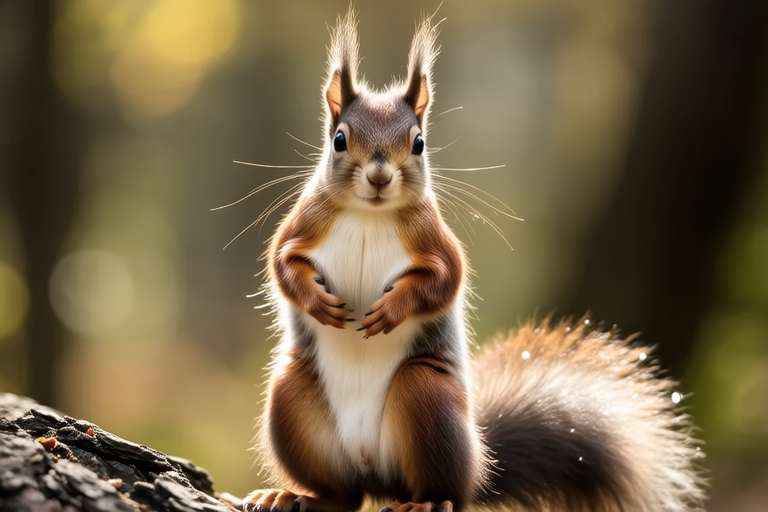
The Great Squirrel Escape: How One Bold Critter Stole the Show
It began with a rustle in the holly bush. A flicker of motion. Then, silence. The kind of silence that makes your spine tingle—like the universe paused for a breath before revealing its next surprise.
And then came the chaos.
In the heart of suburban Maplewood, where lawns were meticulously mowed and flowerbeds bloomed like painted canvases, a tiny, fur-covered rebel had just pulled off the most audacious escape in backyard history. His name? Well, we never officially named him—though neighbors whispered “Sergeant Nutcracker” and “Sir Fluffington”—but his reputation was already legendary.
He wasn’t the biggest squirrel by far. In fact, he looked almost delicate: a russet-furred acrobat with eyes like polished obsidian, a tail so thick it could double as a parachute, and a demeanor that screamed, “I’ve got this under control.” He’d been living in the large, wire-mesh enclosure behind the Henderson family’s deck for nearly three weeks—brought in after being caught mid-raid on their bird feeder. Officially, he was “in temporary custody,” but let’s be honest: no one expected him to break out.
Yet break out he did.
The Plan: Precision, Timing, and a Dash of Daring
It started at dawn, when the world was still wrapped in mist and the only sounds were birdsong and the distant hum of a lawnmower. Sergeant Nutcracker (as we’ll call him) didn’t waste time. He surveyed his prison—a cage with sturdy mesh, a roof made of UV-resistant plastic, and a small wooden platform meant to mimic a tree branch. To most squirrels, it would’ve been a cozy, if slightly confining, home.
To him? It was a challenge.
First, he tested the seams. Not with force—no, that would be too obvious. Instead, he used his sharp claws and nimble paws to gently pry at the edges of the mesh near the corner joint. A little wiggle here, a soft tug there. By mid-morning, a tiny gap had formed—just enough to slip through.
But that wasn’t enough. He needed a distraction.
So he did what any master strategist would do: he launched a full-scale decoy attack on the bird feeder. With lightning speed, he darted across the yard, snatched a sunflower seed, and zipped back to his cage, leaving a trail of crumbs and confusion. The Hendersons, watching from their kitchen window, laughed. “He’s playing possum!” said Mrs. Henderson, sipping her coffee. “That’s not even real food—he’s just trying to make us think he’s hungry.”
Meanwhile, Sergeant Nutcracker was already halfway through the gap.
The Great Leap: A Performance for the Ages
At precisely 10:17 a.m., as the sun climbed higher and the first child from the neighborhood arrived to play hopscotch, the squirrel made his move.
With a flick of his tail for balance, he leapt—not toward the open space, but *upward*. Over the top of the cage, over the plastic roof, and into the air like a furry comet. For one breathtaking second, he hung suspended, silhouetted against the blue sky, tail fluffed like a plume of smoke.
Then—*thud*. He landed on the adjacent oak tree, bounced once, and vanished into the canopy with a triumphant chirp.
“Did you see that?” gasped young Timmy, dropping his chalk in shock. “He jumped… like a superhero!”
Neighbors poured out of houses, phones raised, eyes wide. Some recorded video. Others simply stood frozen, mouths agape, as if witnessing a miracle. One man dropped his gardening gloves and clapped slowly, like he’d just seen a Broadway show.
The Aftermath: Chaos, Laughter, and a Little Heartfelt Respect
Back in the yard, the cage sat empty, the mesh now slightly bent, the plastic roof dented. But the real damage? Emotional.
“He’s gone,” whispered Mr. Henderson, staring at the spot where the squirrel had vanished. “Just… gone.”
His wife placed a hand on his shoulder. “Well,” she said, smiling, “at least he left us with a story.”
By noon, the entire neighborhood was buzzing. Social media lit up with photos of the cage, videos of the leap, and even a fan-made comic strip titled *“Sergeant Nutcracker vs. The Wire.”* Kids drew pictures of him wearing a cape. A local bakery even offered “Nutcracker Nibbles” — mini cookies shaped like squirrels.
But more than the jokes and memes, something deeper stirred. People started noticing squirrels differently. They weren’t just pests stealing birdseed—they were agile athletes, clever problem-solvers, survivors with personalities.
“I saw one yesterday,” said Mrs. Patel, who lived three doors down, “and instead of running away, it stopped, looked me right in the eye, and chattered like it was telling me a secret.”
That’s the thing about urban wildlife: they don’t care about our rules. They live in the cracks between sidewalks, in the shadows of fences, and in the quiet moments when we’re not looking. And sometimes, just sometimes, they remind us that wonder isn’t reserved for remote forests or zoos—it’s hiding in plain sight, in the form of a bold little creature with a plan.
A Lesson in Curiosity and Coexistence
Sergeant Nutcracker may have escaped, but he didn’t vanish from memory. In fact, he became a symbol—a reminder that nature isn’t something separate from our lives; it’s woven into them. That a squirrel can be both a nuisance and a marvel. That curiosity is contagious, and courage comes in many forms—even a tiny, trembling body with a tail full of fire.
Now, whenever someone mentions the “Great Squirrel Escape,” laughter ripples through the neighborhood. But beneath the humor lies a quiet respect—for the wildness that refuses to be caged, for the resilience of creatures who thrive in the spaces we leave behind.
So next time you see a squirrel darting across your lawn, pause. Watch. Wonder. Maybe even offer a nut—just to say thanks.
Because somewhere out there, in a tree, a bold little soul is probably watching back—with a twinkle in his eye and a tale waiting to be told.
After all, the greatest escapes aren’t always about freedom—they’re about reminding us how alive the world still is.
